
 Aging in Place Directory Hub
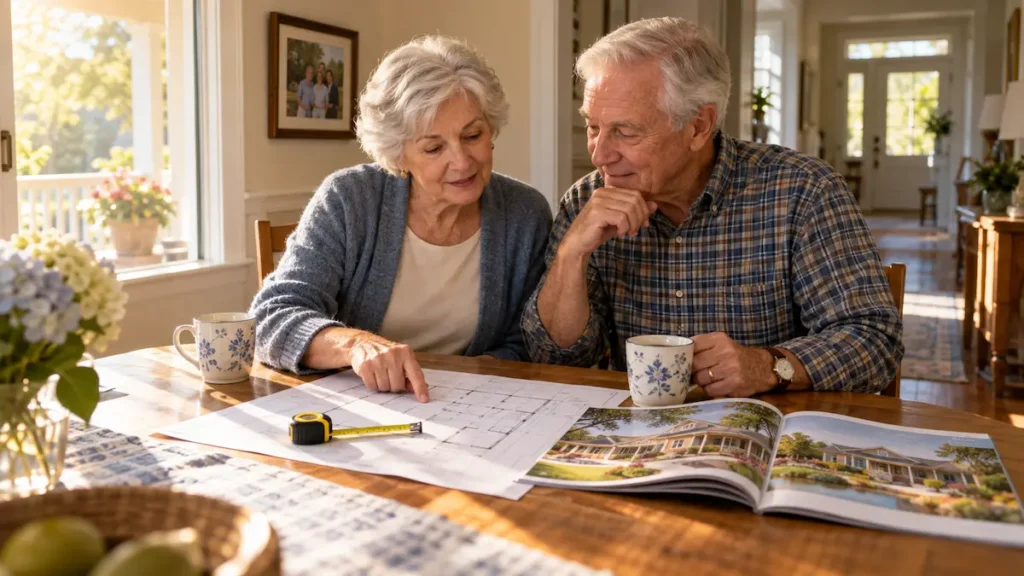
Picture a couple at their kitchen table with two stacks of paper. One stack holds bids from contractors. The other holds brochures from senior living communities. They have been looking at both for three months, and neither stack has gotten any smaller.
I have sat at that table more times than I can count. As an occupational therapist, a Certified Aging in Place Specialist (CAPS), and a Certified Dementia Specialist (C.D.S.), I have walked through hundreds of homes with people trying to answer one question: “Do we fix this house, or do we leave it?”
Most people treat it as a money question. It is really four questions, about your body, your house, your budget, and your people. And in my experience, the biggest mistake is not picking the wrong answer. It is waiting so long that a hospital picks for you.
Remodel if your house can be made safe on one level (a step-free way in, a bedroom, and a bathroom you can use) for far less than a move would cost, and if your friends, doctors, and daily routines are nearby. Move if the house cannot be fixed at a fair price, if you are already isolated there, or if you will soon need daily help that a community can provide more affordably. The best time to decide is while you are still healthy enough to choose, because both paths get harder after a fall or a diagnosis.
Why This Decision Feels So Hard
Both choices feel like losing something. Remodeling can feel like spending real money to admit you are getting older. Moving can feel like giving up the place where your whole life happened. So people do what is human. They wait.
Waiting is a decision, though. It is just the one nobody chose on purpose. I have met people who “decided” to stay by never deciding anything. The upstairs bathroom kept getting harder to reach, and the bids sat on the counter.
Wanting to stay home is very common. A 2021 AARP survey found that nearly 80 percent of adults over 50 would rather stay in their own homes than move in with relatives or into a senior community. That wish is real, and it deserves respect. But a wish is not a plan, and a house does not get safer because you love it.
You should decide before a crisis because after a fall or a hospital stay, you will decide in days instead of months, with fewer choices, less energy, and a body that is still healing.
Adult children feel this pressure too, often from a distance. They see risk. You see your home. Neither of you is wrong, and I will come back to how to talk about that later.
Start With Your Body, Not Your Budget
Before you look at a single bid, ask what your body is likely to need in five years and in ten.
I think of three paths. Some people are on a steady path. They are healthy, and their needs will change slowly. Some are on a changing path, with a condition that is likely to get worse over time. And some are on a sudden path, where a stroke or a fall changes everything in one afternoon. You cannot always know which path you are on. Your doctor or an occupational therapist can help you make an honest guess.
This matters because a remodel that fits your body today may not fit it in eight years. A curbless shower works well with a walker. If you later use a wheelchair, you also need about five feet of open floor to turn around, and a sink and toilet you can use from a seated position. A house that can grow with you is worth far more than a house fixed only for today.
If Memory Loss Is Part of the Picture
A remodel can make a home safer for a person with memory loss, but it cannot supply supervision. Grab bars, stove shut-offs, and door alerts help a great deal in the early stages. Once someone can no longer recognize danger, like a hot burner or a cold night outside, the question changes from “Can the house be fixed?” to “Who is there with them?”
There is a second side to this. A person with memory changes often does best in a place they already know, because the brain leans on old habits and familiar layouts. A move can bring a sharp rise in confusion. Yet waiting too long can make learning a new place nearly impossible. If you think a move may be in your future, it is usually kinder to make it earlier in the process than later.
Ask Your House Three Questions
A house either can be made to work or it can’t, and you can find out faster than you think. I ask three questions.
Can you get in? Look at your entry first. A step-free way in is the first thing most people need. A ramp must rise no more than one inch for every twelve inches of length. If you have three steps that are each seven inches tall, that adds up to about 21 feet of ramp. Some yards have that room. Many do not.
Can you live on one floor? The research here is clear. A Johns Hopkins study that followed more than 7,000 adults over 65 found that having a one-floor home, or having the kitchen, bedroom, and bathroom on the same floor, was the feature most strongly linked to staying put. If your home can offer a bedroom, a full bathroom, and a kitchen on one level with no steps between them, remodeling is usually worth a serious look. A den, a dining room, or a sunroom can often become that bedroom. If nothing on your main floor can, the case for moving gets much stronger.
Can you move around in it? Grab a tape measure. A wheelchair needs a clear door opening of at least 32 inches, and 36 inches is easier. You also want about 60 inches of open floor to turn around in the bathroom, the kitchen, and the bedroom. Widening a doorway costs roughly $600 to $2,000 each. That price climbs fast if the wall holds up the house or has plumbing and wiring inside it.
Some problems I almost never see fixed at a fair price. One is a house where every bedroom and bath sits upstairs, with no room on the main floor to add them. Another is a steep lot with no place to build a step-free entrance. A third is a tiny bathroom surrounded by walls that cannot move. The fourth is a house so far from everything that every errand needs a car. Notice that the last one has nothing to do with the building. I will come back to it.
Before you pay for bids, get an honest outside look. An aging-in-place assessment can show you what your home actually needs, and a room-by-room aging in place checklist can help you start on your own.
Run the Real Numbers on Both Paths
Costs vary a lot from city to city, so treat these as national ballparks and get local numbers before you decide.
| What you are paying for | Typical national cost | How you pay |
|---|---|---|
| A typical aging-in-place remodel (walk-in shower, grab bars, safer fixtures) | $3,000 to $15,000, with an average near $9,500 | One time |
| A full accessible bathroom remodel | $6,600 to $28,000 | One time |
| A stairlift | About $7,000 on average (range $2,300 to $24,000) | One time |
| Independent living | About $3,100 a month | Monthly |
| Assisted living | About $5,900 a month ($70,800 a year) | Monthly |
| Full-time in-home care | About $5,720 a month | Monthly |
Look at the last column. Remodels are paid once. Senior living and care are paid every month for as long as you need them. A targeted remodel often costs less than one year of assisted living, but that comparison is not fair on its own, because a remodel does not provide any care.
A fairer comparison is the remodel plus whatever help you would hire at home, against the monthly fee at a community. Cost surveys commonly show that once you need around eight hours or more of paid help each day, assisted living tends to cost less than hiring that help at home.
Both paths also have costs that do not show up in the brochure.
Staying has its own surprises. Contractors find problems behind walls. You live with dust and noise for weeks. The house still needs a roof, a yard, and gutters. And the care you may need later still has to be paid for.
Moving has surprises too. You pay to sell, to repair, and to move. Communities may charge an entry fee, and monthly fees usually rise over the years. Your favorite chair may not fit the new room. And you may give up a paid-off house with very low monthly costs.
I am not a financial advisor, so please run both plans past someone who is, ideally before you sign a bid or a contract. To see which upgrades are worth the money, this guide to essential home modifications for aging in place is a good place to start.
The Part Spreadsheets Miss: Your People and Your Place
Here is a question I ask every client: “Who would notice if you did not show up on Tuesday?”
In my clinical work, loneliness was one of the quietest reasons a home stopped working. A person goes out less. Cooking for one feels pointless, so they eat less. Their legs get weaker. Then comes a fall that looks like a safety problem but started as a connection problem.
That is why a perfect house can still fail. A remodeled house that sits far from friends, doctors, and stores can fail just as badly as an unmodified one, because the problem was never just the bathroom. Ask yourself whether you could live here if you stopped driving. If the grocery store, the pharmacy, and your friends are all a car ride away, no grab bar will fix that.
It works the other way too. A lovely community that is ninety minutes from your church, your doctor, and your neighbors may remove a hazard and add a deep loneliness. Moving makes sense when it brings you closer to the life you want, not just away from the stairs.
I also ask a simple question: “What do you love about this house?” The answers are rarely about the building. They are about the garden, the kitchen where the kids learned to bake, and the neighbor across the street. Some of those things can be rebuilt or moved. A few cannot. Knowing which is which makes the decision feel lighter.
If You Move, Here Is What Each Option Gives You
Moving is not one choice. It is a handful of very different ones.
A One-Level Home in Your Own Area
This keeps your friends, your doctors, and your routines. You still own and maintain the place, so check it with the same three questions you asked about your current house. A ranch is not automatically a good fit if it has steps at the entry or a bathroom too small to turn around in.
A 55 Plus Community
You get outdoor maintenance, neighbors your age, and a built-in social calendar. Most do not provide care. Ask about stairs, and ask what happens if you need help someday.
Independent Living
You get meals, housekeeping, activities, and often transportation, with no personal care. The national median runs around $3,100 a month. Some campuses, often called continuing care retirement communities, also offer assisted living and nursing care on the same grounds, so you move once. If you look at those, ask about entry fees and what is refundable.
Assisted Living
You get help with bathing, dressing, and medications, with staff around the clock. The national median is about $5,900 a month, and Medicare does not pay for it. This is often the right answer when daily help is needed and the house cannot be made safe.
Moving Near an Adult Child
You get closeness and a family safety net. You also leave your own friends behind. I have seen this go very well when the parent builds a circle of their own in the new town. I have seen it go badly when the parent depends on one busy child for everything.
Moving at 70 is a very different experience from moving at 85. At 70, you join the group, learn the streets, and build a new routine. At 85, often after a fall, you are healing and adjusting to a new place at the same time. In my experience, earlier moves tend to go better.
Three Families, Three Different Answers
These families are based on the kinds of people I have worked with. I changed the details, but the patterns are real.
Frank and Joan, both 71. They lived in a two-story colonial with the bedroom and only full bath upstairs. Friends of forty years lived within a mile. Their main floor had a den and a half bath. They turned the den into a bedroom, expanded the half bath into a full bathroom with a curbless shower, and added a rail and better lighting at the entry. The whole project cost less than one year of assisted living. Two years later, Frank had hip surgery and came home to a bedroom with no stairs. They never had to wonder whether he could come home.
Helen, 79. She was a widow in a 1960s hillside house with fourteen outdoor steps to the front door and bedrooms up a half flight inside. Her daughter lived forty minutes away. Helen had stopped going to church because of the steps. The bids for a ramp or lift were large, and the inside stairs would still have been there. She moved to an independent living community ten minutes from her church. Within weeks she had a lunch group. She told me later that she wished she had moved two years sooner.
Bill and Carol, both 74. They had a ranch house with a small bathroom and a few steps at the entry. They remodeled the bathroom and added a ramp. Then they wrote one sentence on a piece of paper: “If either of us needs help every day, we start touring the community across town.” Six years later, Carol did, and they moved on their own plan, to a place they had already visited twice. Nobody had to make the choice in a hospital hallway.
What do these three have in common? Each looked honestly at the body and the house. Each decided early. And each could explain why. Their answers were different because their houses and their lives were different.
How I Help Families Decide
If you are stuck, here is how I would work through it with you at your kitchen table.
First, Get an Outside Eye
You are too close to your own house to see it clearly. A CAPS professional or an occupational therapist can watch how you actually move through your home and point out what you have stopped noticing. Ask your doctor whether a doctor’s order can help cover an occupational therapy home evaluation.
Second, Price Both Paths for Ten Years
Take two sheets of paper. On the first, write the cost of staying: the remodel, upkeep, taxes, insurance, and any help you expect to hire. On the second, write the cost of moving: selling, moving, monthly fees, and new furnishings. A ten-year view shows what a one-year view hides. Then take both sheets to a financial professional.
Third, Write Down What You Cannot Give Up
List three things. It might be your garden, your church, and a daughter ten minutes away. Then test each path against that list. The path that protects more of it is usually your answer, even if it costs more.
Fourth, Set Your Trigger
You do not have to pick one path forever. Many people remodel now and plan to move later. Others move now and modify the new place. Either way, write down a clear line, such as “If I need help with bathing every day, we start touring.” A trigger turns “someday” into a plan. It also lifts the guilt later, because you decided while you were healthy.
When You and Your Family Do Not Agree
This is where many families get stuck. The parent hears “You can’t stay here.” The child hears “Stop worrying about me.” Both are scared.
If you are the adult child, lead with questions instead of verdicts. Try, “What would need to be true for you to feel safe here?” or “What worries you most about moving?” If a parent can still understand the choice and weigh the risks, the decision belongs to them, and the family’s job is to make sure it is an informed one. If memory changes are affecting their judgment, that changes the picture, and their doctor should be part of the conversation.
If you are the older person, and your children are pushing you to move, ask them for their specific worries. “I worry about the stairs” is something you can fix. “I worry about everything” is a feeling you can talk about.
When the conversation stalls, a neutral person helps. An occupational therapist can assess the home. A geriatric care manager can look at the whole situation and lay out options without taking a side.
Neither Choice Is a Failure
Remodeling is not stubbornness. Moving is not giving up. Both can be good choices, and both can be poor ones, depending on the person and the timing.
The goal was never the house. It was safety, dignity, connection, and a real say in your own life. If a remodel protects those things, wonderful. If a move protects them better, you have lost nothing that matters.
The wrong time to decide is in the middle of a crisis. Almost any other time is better.
Pick One Step This Week
You do not need to solve this today. Pick one small step.
Measure the doorways on your main floor and write down the numbers. Or write down what you love about your house. Or book an assessment. Or ask someone you trust, “If the stairs got hard, what would you want me to do?”
In all my years of walking into people’s homes, the ones who felt at peace with their choice were rarely the ones who spent the most money. They were the ones who looked at the facts early, asked for help without shame, and chose the path that kept their life full. You can do that too.
