
 Aging in Place Directory Hub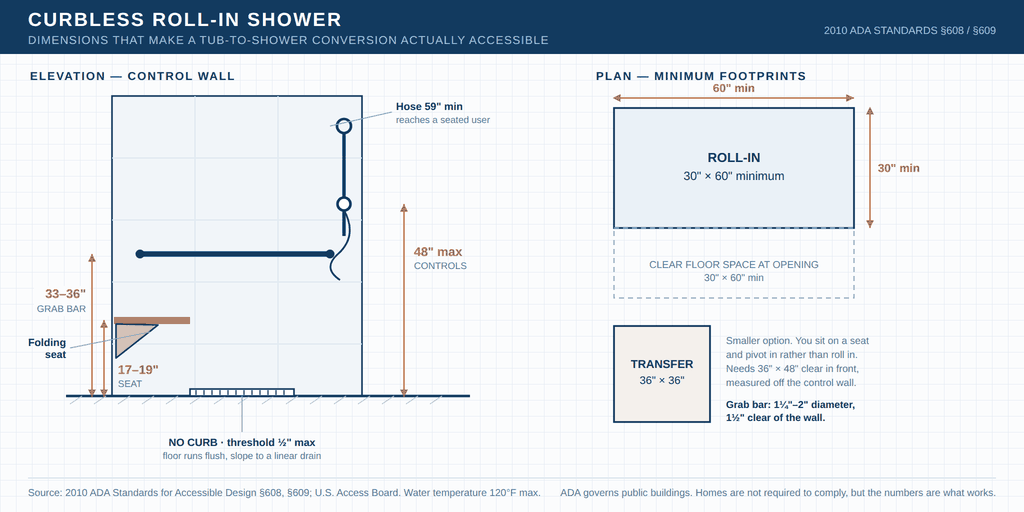
When my mom slipped in the shower a few years ago, my sister, who was her caregiver, froze. She was lucky. No broken bones, just a bruised hip and a frightened daughter.
In my years as an occupational therapist I saw the same thing over and over. I have seen patients struggling just to get into the tub. One misstep and they could fall hard. The tub wall is fifteen inches of the most dangerous real estate in the house, and eventually every family looks at it and asks the same question: what would it cost to just take it out?
If you are reading this, you are probably pricing a tub to shower conversion for a parent, a spouse, or yourself. You have gotten one quote that seemed high, or no quote at all, and you want to know what this should actually cost before you call anyone.
Quick answer: The spread is that wide because “conversion” covers four completely different jobs. A tub cut runs $800 to $1,800.00 A curbless wheelchair-ready shower runs $8,000 to $15,000 and up.
Most people only get quoted the expensive one. That is the problem this guide solves.
Prices below reflect national contractor data published between med-2025 and September 2026. Costs vary by region, so treat these as a bracket to check your quote against, not a promise.
Let me walk you through all four, what each one is actually right for, and what to do if the number you need is bigger than the money you have.
Why the price swings so much
Every cost article you find gives you one range and leaves. That is not useful when the ranges go from $800 to $15,000.
Here is what actually moves the number:
- Whether the walls open up. If the plumber has to move a drain, you are in a different price bracket. A tub drain and a shower drain are not in the same place.
- Whether the floor changes. A curbless entry means the subfloor gets lowered or the pan gets sloped. That is structural work.
- Whether the door gets wider. A 24-inch bathroom door does not admit a walker. Widening to 32 or 36 inches means framing.
- Whether you need blocking. Blocking is plywood behind the tile so grab bars can go anywhere later. It costs almost nothing during a remodel and a fortune afterward.
That last one is the single most expensive mistake I see. Put the blocking in now.
Does Medicare cover a tub to shower conversion?
No. Original Medicare treats a shower conversion as a home modification, not durable medical equipment, so Parts A and B will not pay for it. Some Medicare Advantage plans cover a portion under Special Supplemental Benefits for the Chronically Ill. Call your plan and ask about home modification benefits under SSBCI before you assume the answer is no.
The four conversions, cheapest to most involved
Option 1: Make the tub you already have safer
$150 to $1,600
Before you spend $10,000, find out whether you need to. A tub with proper grab bars, a transfer bench and a handheld shower is safe for a lot of people, and you can have it done this week instead of next quarter.
- Best for: Someone who can still swing a leg over the tub wall with support. This is also the only tier that works in a rental, since a bench, a mat and a handheld leave no marks and come with you when you move. Grab bars go into studs, so ask your landlord in writing first.
- Timeline: One to two days
- What you get: Grab bars mounted into studs, a bench that lets you sit to transfer, a handheld so you are not turning under the water
Installed grab bars run $150 to $500 each, a fold-down shower seat runs $300 to $800 installed, and a handheld showerhead runs $100 to $300 installed, according to This Old House. Buying the parts yourself and paying a handyman by the hour to hang them brings that down considerably.

- DURABLE & SUPPORTIVE CONSTRUCTION: 24-inch long stainless steel grab bar with 1.25 inch diameter; supports up to 500 lbs when installed in a stud or when using SecureMounts (not included)
- EASY INSTALLATION: SecureMount design for easy, secure installation (sold separately) delivering safety and peace of mind
- STYLISH STAINLESS FINISH: Stainless finish delivers a lightly brushed warm gray metallic look and coordinates with other Moen bathroom accessories and hardware


- HEAVY DUTY BATH AND SHOWER BENCH—For seniors and mobility-impaired individuals; use as tub transfer bench or bath seat for easy entry and exit; high-strength, rust-resistant aluminum frame; 400 lb. weight capacity; 11 lb.
- EASY ADJUSTABLE HEIGHT SETTINGS AND REVERSIBLE BACKREST – Easy push-button design for simple, custom seat height adjustment from 17.5-22”. Reversible backrest fits on either side of seat to accommodate any shower or tub.
- BACKREST and ARM REST – Get extra stability and support when sitting down or getting up. Reversible backrest can be positioned on either side to fit most tubs; Stationary arm rest stays on one side.

- Professional grade sliding transfer shower bench, bath, and shower chair for inside shower. Effortless sliding and pivoting for safe, easy transfers in and out of the tub. Platinum health products are used in thousands of hospitals, nursing homes, and private homes by customers who value quality, safety, convenience, and comfort over price. Note: optional leg extension kit available for tubs with high ledge.
- Padded shower seat, back, and armrests. No more cold, slippery, hard plastic parts like old-style bath chairs; the well-made carousel provides warm-to-the-touch, comfortable, slip-resistant padding on all main components. The medical-grade, closed-cell molded polyurethane padding on this shower chair for the bathtub will not absorb any water and is easy to clean and disinfect.
- Swivel-seat space-saving design. Not only is the swivel seat safer, easier to use, and more comfortable than a standard fixed seat, this bath chair shower chair for seniors design means that the chair protrudes into the room much less than a traditional transfer bench. More convenient for the user, and more convenient for others that don’t require the use of the chair since the free space in the bathroom is much greater.

- Lumicoat Finishes easily wipe clean without cleaners or chemicals and are guaranteed to resist mineral buildup and hard water stains on the product’s most commonly touched areas
- ProClean spray cleans shower surfaces at least two times faster than standard sprays
- Power off stubborn soap scum, hair and shower messes
Tip: A transfer bench that straddles the tub wall is the single highest-value item on this list. It turns a step-over into a sit-and-swing, which is a completely different physical demand.
A client of mine with Parkinson’s used a combination of vertical and horizontal bars to move from the shower seat to standing. It worked wonders for his confidence, and it cost a fraction of a remodel. Before you price a conversion, find out whether this is your answer.
Option 2: The tub cut
$800 to $1,800
A technician cuts a step-through section out of the side of your existing tub and finishes the opening. The tub stays. The wall of it does not.
- Best for: A tight budget, a one-bathroom house that cannot lose its only tub for three weeks, a household that still wants a tub for grandchildren, or a landlord making a unit workable for an aging tenant. Some systems use a removable insert that puts the tub wall back.
- Timeline: Usually one day
- What you get: A step-in height of a few inches instead of fifteen
This is the most underused option in the whole category. HomeGuide puts tub cut conversions at $800 to $1,800. Compare that to a $10,000 remodel and it is worth a phone call before you commit.
Does a tub cut hurt my home value?
A cut tub does look unusual to a buyer, so if you expect to sell within a couple of years, Option 3 is the better spend. If you are staying put, this is not worth losing sleep over. Ask your installer whether their system takes a removable insert, which puts the tub wall back for bathing or for a showing.
Can I do any of this in a rental?
It depends which side of the lease you are on.
If you rent, Option 1 only. A tub cut permanently alters the tub, so it is not a tenant’s option at all, whatever a salesperson tells you. A transfer bench, a non-slip mat and a handheld showerhead need no permission and travel with you when you move. Grab bars anchor into studs, so get your landlord’s approval in writing before anyone drills.
If you own the home someone else lives in, a tub cut is often the smartest money on this page. That includes landlords with a long-term older tenant, and the very common case of an adult child who owns the house a parent lives in. Under $1,800, done in a day, usually no permit, no tenant displaced, and a removable insert restores the tub for the next occupant. A $10,000 conversion on a property you do not live in rarely makes sense. This one does.
It is also worth asking. A good tenant who wants to stay another ten years is worth more to a landlord than the cost of a tub cut, and many have never been asked.

- ✅No Drilll Installation: The shower head bracket has powerful adhesive stickers no drilling and no damage to the wall. The handheld shower holder has waterproof and won’t fall off even washed by the water. (Attention: This adhesive tape has the properties of glue. Please make sure to mark the installation position accurately. Once it is pasted onto the wall, the adhesive type cannot be reused.)
- ✅Low-Reach Adhesive Wall Mount: which can be fixed at the wanted position, especially for kids and elders. It will help them to shower by themselves and enjoy private time fully.
- ✅2 Options Installation for Choose: Screw and adhesive sticker installations, the screw installation can be done on any wall surface. The adhesive installation can only be carried out on smooth surfaces such as marble and tiles. Of course, both installation methods can be used together to make it even more stable.
Option 3: The full walk-in shower conversion
$2,000 to $12,000, prefab through custom tile
The tub comes out and a real shower goes in. Where you land inside that range depends almost entirely on what the shower is made of.
- Prefabricated stall: $2,000 to $6,000
- Walk-in shower: $5,000 to $12,000
- Custom tile: $6,000 to $12,000
Those figures are from This Old House’s 2026 guide. Angi puts the overall average for a tub to shower conversion at $3,000, with a typical range of $1,200 to $15,000, which tells you how much the prefab option pulls the average down.
- Best for: Most people doing this before a crisis
- Timeline: One to three weeks
- Watch for: A low threshold is not the same as no threshold. Ask which one you are getting.
Note: Add-on costs nobody quotes upfront, and the three sources disagree sharply on them. Angi puts permits at $200 to $2,000, old tub removal at $150 to $300, a basic shower door at $600 to $1,350 and plumbers at $45 to $200 an hour. HomeGuide is much lower on two of those, at $30 to $400 for permits and $70 to $800 for tub removal. This Old House puts tub removal higher still at $300 to $1,200, and a frameless door at $1,200 to $3,000. Ask your own contractor to price these as line items.

- BATHE WITH TOTAL SECURITY: Engineered for reliable stability, this heavy-duty shower chair features a reinforced aluminum frame with crossbar support, lab-tested to hold up to 550 lbs. Combined with non-slip rubber feet, it provides strong, reliable support on wet floors to help banish worries about slips or wobbles, allowing users of various sizes to shower with greater confidence and security
- FITS YOUR BODY & BATHROOM: Adjust the seat to 6 height positions (Floor to seat height: 15″–20″) to perfectly fit users from 5’3″ to 6’5″. Convert between 4 setups using the removable back and arms — from a simple stool to a full-support chair — creating a personalized bathing experience that adapts to your needs and space
- CUSTOMIZE BATHING COMFORT: Enjoy a safer, more comfortable shower with everything within reach. This chair includes a showerhead holder for easy rinsing and a 22-inch wide seat with 12 quick-drain holes to stay dry. The supportive EVA cushion and padded armrests offer added comfort and stability, while rust-resistant materials ensure lasting reliability—ideal for seniors, those recovering, or anyone seeking safer, more independent daily living

- ▶【NEW SPECIAL ON/OFF SWITCH BUTTON】: Stop water-saving function, no need to close the middle multi-function valve, let your bath or washing hair easier. Especially for adult, disabled, toddler, baby.
- ▶【3 ADJUSTABLE HAND SHOWER SETTINGS】: KAIYING 3 functions bathroom shower head will present drenching rainfall, invigorating massage, and powerful jetting modes. With 344 pinholes that make the generated water mist be thicker, give you a best shower experience!
- ▶【HIGH WATER PRESSURE】: High pressure shower head will provide you adequate water and comfortable shower time even if your house is the high-rise. Also provides powerful spray performance even under low water pressure.
Option 4: Curbless and wheelchair accessible
$8,000 to $15,000 for the shower alone.
This is the version that assumes a wheelchair, a walker, or a caregiver helping in the room.
A curbless shower alone runs $8,000 to $15,000 per This Old House, and Angi prices a curbless or barrier-free stall at $2,000 to $4,100 before the floor work. A full handicap-accessible bathroom remodel averages $8,400 with a typical range of $5,600 to $12,000. That reads lower than the curbless shower figure above because the two publishers scope the job differently, not because a whole room costs less than the shower inside it. ADA-compliant fixtures alone run $3,000 to $15,000. When walls move, it goes higher.
What makes it different from Option 3:
- Roll-in entry, zero threshold, with the floor sloped to a linear drain
- A 36-inch doorway, which delivers the 32 inches of clear width the ADA asks for and usually means reframing
- Turning clearance, generally a 60-inch circle inside the room
- A roll-under sink with the trap insulated so knees do not contact hot pipe
- Blocking everywhere, because bar placement will change as needs change
The specs your contractor should be working to
These are the 2010 ADA Standards, as published by the U.S. Access Board. Worth knowing before you sign anything, because a contractor who has never done accessible work will guess at them.
| Element | Requirement | ADA section |
|---|---|---|
| Roll-in shower size | 30″ wide x 60″ deep minimum | 608.2.2 |
| Transfer shower size | 36″ x 36″ clear inside | 608.2.1 |
| Clear floor space at the opening | 30″ x 60″ minimum | 608.2.2 |
| Threshold | 1/2″ maximum | 608.7 |
| Grab bar height | 33″ to 36″ above the finished floor | 609.4 |
| Grab bar diameter | 1 1/4″ to 2″ | 609.2 |
| Space between bar and wall | 1 1/2″ | 609.3 |
| Folding seat height | 17″ to 19″ | 610.3 |
| Controls | no higher than 48″ | 608.5 |
| Handheld hose length | 59″ minimum | 608.6 |
| Water temperature | 120°F maximum | 608.6 |
One thing to understand about that table: the ADA governs public buildings, not private homes. Nobody is going to cite your bathroom. But these numbers come from decades of research into what a person with limited mobility can actually use, so a contractor who ignores them is guessing, and you are the one who lives with the guess.
What size does a roll-in shower need to be?
A roll-in shower is 30 inches deep by 60 inches wide at minimum, with a clear floor space 30 inches deep and 60 inches long running along its open face. If your existing tub alcove is the standard 60 inches long, you may be closer than you think, because a standard tub footprint and a minimum roll-in shower footprint are nearly the same. The constraint is usually the door and the turning circle, not the shower.

- PREMIUM MATERIAL: Our toilet handicap grab bar is made of heavy duty 304 stainless steel which is waterproof, rustproof,and sturdy.The toilet grab bar is able to support up to 500 lbs of pull force to provide a stable,reliable handhold.U-shaped grab bars for the bathroom bring higher load-bearing capacity.
- NON-SLIP AND RELIABLE:The 32 inch safety bars for toilets,considering that the smooth surface of stainless steel is not conducive to power assist,toilet support bars unique non-slip surface with a knurled surface,the anti-slip function works well even with wet hands or in a wet bathroom.
- SPACE SAVING: The grab bar toilet can 90-degree vertical swivel, flip up grab bar makes it easier for users with limited mobility to use the bathroom independently,it can be easily folded out of the way when not in use,folding grab bar help saving precious bathroom space.With a paper holder design,fold down toilet grab bar more convenient to use.
Cost comparison at a glance
| Option | Cost | Time | Best for |
|---|---|---|---|
| Safer tub | $150–$700 | 1–2 days | Can still step over with support. Only rental-friendly tier |
| Tub cut | $800–$1,800 | 1 day | Tight budget, only one tub, or a landlord |
| Prefab stall | $2,000–$6,000 | 1–2 weeks | Most straightforward replacements |
| Walk-in shower | $5,000–$12,000 | 2–3 weeks | Planning ahead, staying long term |
| Tile walk-in | $6,000–$12,000 | 2–3 weeks | Resale value matters |
| Curbless | $8,000–$15,000+ | 3+ weeks | Walker, wheelchair, or caregiver assist |
| Full accessible bathroom | $5,600–$12,000 avg $8,400 | 3–6 weeks | Wheelchair use, room reconfiguration |
What if the number is bigger than what you have?
This is the part of the conversation that most guides skip, and it is the one families get stuck on. There is more money available than people realize, and the order you go after it matters.
**Start with the VA if there is a veteran in the house.** These are the largest numbers in the whole category and almost nobody knows the figures.
| VA grant | FY 2026 maximum | Uses |
|---|---|---|
| Specially Adapted Housing (SAH) | $126,526 | up to 6 in a lifetime |
| Special Home Adaptation (SHA) | $25,350 | up to 6 in a lifetime |
| Home Improvements and Structural Alterations (HISA) | $6,800, or $2,000 | lifetime benefit |
A qualifying disabled veteran can have an accessible bathroom built almost entirely on grant money. Start at va.gov before you do anything else.
**Then check USDA** if the address is rural. Section 504 offers a $40,000 loan at 1% fixed over 20 years, plus a $10,000 grant if the homeowner is 62 or older, combinable up to $50,000. Income limits apply by county, and the grant has to be repaid if you sell the home within three years.
Then your state Medicaid waiver. Home and Community-Based Services waivers cover home modifications in most states. The money is real and the waiting lists are long, so apply early.
Then your Medicare Advantage plan, if you have one. Ask specifically about home modification benefits under SSBCI.
This one surprises people, so let me give you two real examples. When I visited Mrs. Lopez, age 82, she told me, “I’ll wait until I fall before adding bars.” She believed Medicare would never help. Her Medicare Advantage plan covered up to $2,200 for bathroom safety upgrades under her Evidence of Coverage, and two weeks later she had three ADA-compliant bars installed by a licensed contractor.
My own dad always said, “I don’t need help.” After he failed his Timed Up and Go test at 14.6 seconds, his functional mobility score qualified him for benefits. His plan paid $1,800 to install two horizontal grab bars by the tub and one vertical entry bar at the shower. His cost was a $35 copay.
Neither of them paid for a full conversion this way. Two plans is not a pattern, and yours may cover nothing at all. But it costs one phone call to find out, and if your plan does cover hardware at that level, that is money you do not have to borrow.
Do not forget the tax deduction. IRS Publication 502 treats a home improvement made primarily for medical care as a deductible medical expense, reduced by any increase in your home’s value. The IRS specifically lists improvements that usually do not increase home value, and the list is essentially an accessibility scope of work: widening doorways, widening or modifying hallways, installing railings or support bars in bathrooms, adding grab bars anywhere, modifying stairways. For those items the full cost can count as a medical expense. Three conditions come with that: the work has to accommodate a disability of you, your spouse or a dependent; you have to itemize; and only the portion of your total medical expenses above 7.5% of your adjusted gross income is deductible. Take it to a tax preparer with your receipts.
One important sequencing rule: apply for grant money before the work starts. Most programs will not reimburse a finished bathroom.
When grants do not cover it: a word from a mortgage broker
I asked Christopher Gibson to explain the part I am not qualified to. He is a mortgage broker with C2 Financial, NMLS #1910430, and he works primarily in reverse mortgages. Licensed in Washington, Colorado, Texas, Florida and Michigan.
Here is what usually happens on these files. The senior has the equity. A 74-year-old on Social Security and a small pension can be sitting on $600,000 in the house, own it free and clear, and still get turned down for a $40,000 home equity line. It is not credit. It is income. A HELOC requires a monthly payment, and underwriting has to see enough income to support it. That call happens more often than people would guess.
A reverse mortgage has no required monthly payment. You still owe property taxes, homeowners insurance and upkeep, and staying current on those is what keeps the loan in good standing. But there is no principal and interest payment to qualify for, so the income problem that stops the HELOC does not stop this.
It can also erase a payment you already have. A reverse mortgage pays off any existing mortgage first. If there is still a balance on the house, that monthly payment goes away at closing. People come to me about a bathroom and leave with the bathroom handled and their largest monthly bill gone. If you are still making a mortgage payment, that part is often worth more to you than the remodel is.
Before you touch the IRA, do this math. Most people I talk to assume the retirement account is the obvious place to get $12,000. It often is not, and the reason is taxes. A withdrawal from a traditional IRA or 401(k) is ordinary income. The IRS treats reverse mortgage payments as loan proceeds and not income, which is true of any loan. So to hand the contractor $12,000 out of an IRA, you have to withdraw meaningfully more than $12,000 to cover the tax on it. Worse, that extra income can make more of your Social Security taxable in the same year. Run both numbers past your tax preparer before you take the distribution. I have seen the loan cost less than the withdrawal.
A HELOC can be frozen. This cannot. This is the part almost nobody knows. In the CFPB’s own words, home equity plans “generally permit lenders to freeze or reduce a credit line if the value of the home declines significantly or when the lender reasonably believes that you will be unable to make your payments due to a material change in your financial circumstances.” That is from the CFPB’s booklet on home equity lines, and it is exactly what happened to a lot of people in 2008 and 2009. They had a line, they were counting on it, and one day it was gone. A reverse mortgage line of credit does not work that way. Once it is in place, the money stays available to you.
The loan is non-recourse. On a HECM, neither you nor your kids can ever owe more than the house is worth when it sells: if the balance ends up higher than the sale price, the FHA insurance on the loan covers the difference, not your estate. Heirs who would rather keep the house than sell it pay no more than 95% of its appraised value. Proprietary reverse mortgages are non-recourse by contract rather than by FHA insurance, so on those, ask the lender to show you the clause in writing. The CFPB puts it this way: you will never owe more than the value of the house, you or your heirs may not have to pay the difference.
The government-insured HECM starts at age 62 and proprietary programs from private lenders start at age 55, which matters for people doing this work early rather than after a fall.
The trade-off: the balance grows instead of shrinking, so there is less equity at the end. That is the product working as designed, and it is right for some families and wrong for others. Someone planning to sell in three years should not do this. Someone who intends to stay in the house, and who needs the bathroom to be safe for that to happen, should at least run the numbers.
Every HECM requires independent HUD-approved counseling before an application moves forward, on every file in every state.
If you are weighing a home equity loan against a reverse mortgage and you are over 55, the comparison is worth running before the contractor’s quote expires. I lay out how a reverse mortgage line of credit works for seniors, including what it costs, and you can reach me at 720-449-6622.
Christopher Gibson, mortgage broker, C2 Financial Corporation, NMLS #1910430
Take your next step
- Walk the bathroom and decide which of the four options you actually need. Most people need less than they think.
- Get the blocking in, whatever you do. It is cheap now and expensive later.
- Get two quotes, not one. The spread on this work is enormous.
- Apply for grant money before the work starts.
- Ask the contractor for the ADA specs in writing if anyone in the house uses a walker or wheelchair. Low threshold and zero threshold are different products.
Need help finding someone who does this work properly? Use the Aging in Place Directory to find a CAPS-certified remodeler in your area. If you cannot find one near you, let me know and I will look for you and email you a list.
When my friend’s mother finally had hers done, she smiled and said, “Now I don’t feel scared in there anymore.” That is what you are actually buying here, and it does not always take $12,000 to get it.
You do not have to wait for a fall to make the bathroom safe. Start with whichever of the four options fits, today.
