
 Aging in Place Directory Hub
A home safety assessment is a structured walk-through of a senior’s living space to identify fall risks, mobility barriers, and hazards that could cause injury. A trained professional evaluates every room, from the bathroom to the bedroom, and recommends changes like grab bars, better lighting, or ramp installations. Most assessments take one to two hours and can dramatically reduce the risk of falls and accidents at home.
Margaret had lived in her two-story colonial for 38 years. She knew every creak in the floorboards, every corner of her kitchen.
But after her hip replacement surgery, her daughter noticed things Margaret had stopped seeing: the loose rug at the top of the stairs, the dim hallway light, the step up into the shower.
What Margaret’s family had stumbled onto was something I see in nearly every home I visit. Familiarity hides danger. When you’ve lived somewhere long enough, you stop seeing the hazards, you just navigate around them, until one day you can’t.
That’s exactly what a home safety assessment is designed to catch. If you’re wondering whether your home, or the home of someone you love, is truly safe for aging in place, keep reading. This may be the most important conversation you have this year.
What Is a Home Safety Assessment?
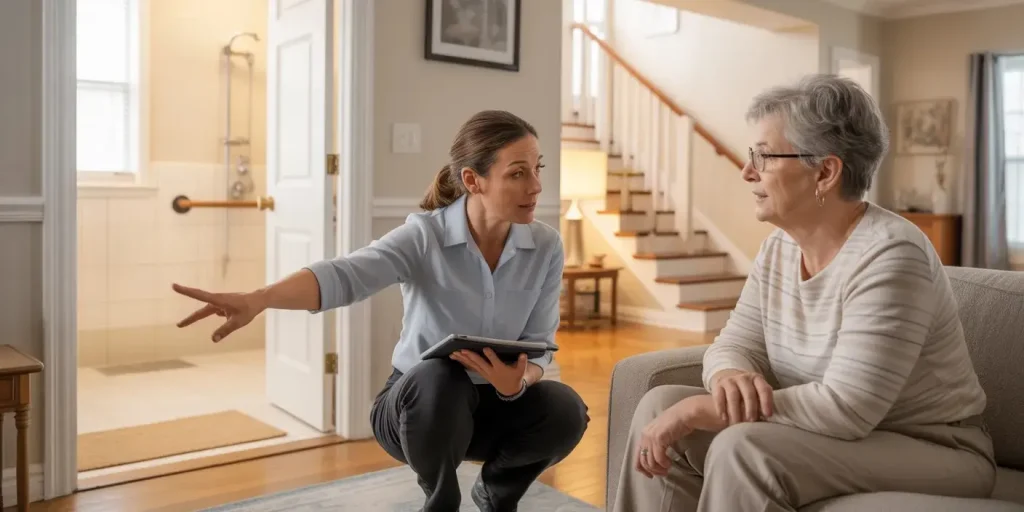
A home safety assessment is a professional evaluation of a senior’s living environment, focused on identifying conditions that increase the risk of falls, injuries, or accidents.
During the assessment, a trained evaluator, often an occupational therapist, a Certified Aging-in-Place Specialist (CAPS), or a home health professional, walks through the home room by room. They look at the physical layout, the lighting, the flooring, the bathroom setup, entryways, stairs, and more.
The goal isn’t to find fault with how someone lives. The goal is to make sure the home supports independence, safety, and dignity as a person’s needs change over time.
Why Do Seniors Need a Home Safety Assessment?
Falls are the leading cause of injury-related death among adults 65 and older, according to the Centers for Disease Control and Prevention. And the majority of those falls happen at home, in familiar spaces the person has navigated for years.
This happens because aging changes our bodies in ways that sneak up on us. Balance shifts. Vision changes. Medications affect coordination. Strength and reaction time decline gradually, so we don’t notice until something goes wrong.
A home that was perfectly safe at 55 may have real dangers at 75. The assessment bridges that gap, it looks at the home through the lens of who you are today, not who you were when you moved in.
What Does a Home Safety Assessment Include?
A thorough assessment covers every area of the home where a senior spends time. Here’s what a qualified evaluator will examine:
- Entryways and exterior: Steps, railings, lighting, door thresholds, and path surfaces
- Living and dining areas: Furniture placement, rug security, cord management, lighting levels
- Kitchen: Cabinet height and reach, appliance safety, flooring slip risk, accessibility of frequently used items
- Bathroom: Grab bar placement (or absence), shower and tub entry, toilet height, non-slip mats, water temperature settings
- Bedroom: Bed height, nighttime lighting, pathway to the bathroom, emergency call access
- Stairs and hallways: Handrail stability, step visibility, lighting switches at both ends
- Emergency preparedness: Smoke and carbon monoxide detectors, ability to exit safely, phone or alert device accessibility
After the walkthrough, you’ll receive a written report with prioritized recommendations. Some changes are small and low-cost. Others, like widening doorways or installing a walk-in shower, are larger projects. A good evaluator will help you understand which changes matter most.
Who Should Perform a Home Safety Assessment?
Not all assessments are created equal. Who performs the assessment matters just as much as what they evaluate.
An occupational therapist (OT) is the gold standard. OTs are trained to connect physical function with the environment, they understand how specific health conditions, medications, or mobility limitations affect how a person moves through their home. Many OTs specialize in home modification and aging in place.
A Certified Aging-in-Place Specialist (CAPS) — a designation offered through the National Association of Home Builders, is a contractor or design professional trained specifically to modify homes for aging seniors. CAPS professionals focus more on the construction and design side of modifications.
Some home health agencies, Area Agencies on Aging, and senior care nonprofits also offer free or low-cost assessments, especially after a hospital discharge or following a fall.
Ask questions before you agree to any assessment. Find out what training the evaluator has, what the assessment covers, and whether you’ll receive a written report with specific recommendations.
What Are the Signs That a Home Needs to Be Assessed?
You don’t have to wait for a fall or a hospital stay to request an assessment. These are signs I tell families to watch for:
- A parent or loved one has had a recent fall, even a minor one
- There’s been a significant health change, a new diagnosis, surgery, or new medication
- The person is using a cane, walker, or wheelchair for the first time
- You’ve noticed the senior avoiding certain rooms or activities (this often signals fear of falling)
- The bathroom lacks grab bars and the person has trouble getting in and out safely
- The home has stairs the senior now struggles with
- Nighttime trips to the bathroom have become frequent or unsteady
- Cognitive changes are making it harder to remember hazards or navigate safely
Any one of these is enough reason to schedule an assessment. You don’t need a crisis to justify being proactive.
What Happens After a Home Safety Assessment?
The assessment itself is just the beginning. What comes next is where the real protection happens.
After your evaluation, you’ll receive prioritized recommendations. A good evaluator will separate the urgent fixes, like a missing grab bar in a shower used by someone with balance issues, from the longer-term improvements that can be phased in over time.
Here’s what I recommend to every family I work with:
Start with the bathroom. It’s the room where most in-home falls occur, and the fixes are often affordable. A grab bar near the toilet and a handheld showerhead can make a significant difference without major renovation.
Then look at lighting. Add nightlights in hallways and near the bed. Make sure light switches are accessible before entering a dark room.
Secure or remove rugs. Loose area rugs are one of the most common fall triggers I find in homes, and they’re one of the easiest to address.
For larger modifications, talk to a CAPS contractor about phased projects. Many families are surprised by how much can be done without a full renovation.
A Story Worth Sharing
I think of a woman named Patricia, 81, who lived alone in the home she and her husband had built together in 1972. After her husband passed, her daughter Linda started noticing that Patricia was spending most of her time in the living room, she wasn’t going to the kitchen as often, and she’d started sleeping in the recliner instead of her bedroom.
When we did a home safety assessment together, we found out why. The hallway to the bedroom was dark and narrow, and Patricia had quietly become afraid of navigating it at night. She hadn’t said a word about it to Linda.
We added motion-sensor nightlights, widened the visual path by moving a side table, and installed a grab bar just inside the bedroom door. Within a week, Patricia was sleeping in her own bed again.
The lesson I take from Patricia is this: sometimes the danger isn’t visible. Sometimes it’s a quiet behavior change, an avoidance, that tells the real story. A home safety assessment gives you a professional set of eyes on a space that has become invisible to the people who live in it.
Conclusion
When my own mother started aging in place, I thought I knew what to look for. I had the training. I had the credentials. And still, I missed things, because I was her daughter first and a professional second. Familiarity does that to all of us.
A home safety assessment isn’t a sign that someone is failing. It’s a sign that you’re paying attention. It’s one of the most loving, practical things a family can do, and one of the most effective ways to protect independence and reduce the risk of a catastrophic fall.
If you’re not sure where to start, contact your local Area Agency on Aging, ask your primary care doctor for an occupational therapy referral, or reach out to a CAPS professional in your area. The assessment is just a conversation, one that could change everything.
Frequently Asked Questions
How much does a home safety assessment cost? The cost varies depending on who performs the assessment and where you live. Occupational therapist evaluations typically range from $150 to $500, though many are covered by Medicare following a qualifying health event like a hospitalization or fall. Some Area Agencies on Aging and nonprofit senior services offer free assessments. Always ask about coverage before scheduling.
Can a family member do a home safety assessment instead of a professional? A family member can do a basic walk-through using a published checklist, and that’s a helpful starting point. But a trained professional will catch things a family member is likely to miss, especially hazards related to specific medical conditions, mobility limitations, or medication side effects. For the most complete picture, a professional evaluation is worth the investment.
What is the most common hazard found in a home safety assessment? In my experience, the most consistently dangerous finding is bathroom safety, specifically the absence of grab bars near the toilet and in the shower or tub. Bathrooms combine wet surfaces, balance challenges, and awkward movements, which makes them the highest-risk room in most homes. Fortunately, grab bar installation is also one of the most affordable and impactful changes you can make.
