
 Aging in Place Directory Hub
For years, when people thought about “technology for seniors,” they pictured one thing: a medical alert button.
You know the kind.
The “I’ve fallen and I can’t get up” commercials.
As a retired Occupational Therapist who worked with older adults, I understand why those devices became popular. They can absolutely save lives. But I also know something else…
Most older adults do not want to feel like they are wearing a symbol of decline.
Many seniors want support, safety, connection, and independence without feeling like they are being turned into a patient.
And honestly, I think that’s one of the biggest problems with a lot of senior technology today. It focuses almost entirely on emergencies instead of everyday living.
The best aging-in-place technology should not just react when something goes wrong. It should help older adults stay connected, engaged, confident, and involved in life before a crisis ever happens.
Surprisingly, one of the best tools for doing that may already be sitting in the living room.
The television.
The Problem With “Modern” Senior Technology
For years, tech companies pushed tablets as the answer for older adults. At first, that sounds logical. Tablets are portable, lightweight, and filled with apps.
But real life is different.
Many seniors struggle with:
- Arthritis
- Tremors
- Vision loss
- Hand weakness
- Forearm fatigue
- Memory problems
- Complex menus and settings
I have seen this happen over and over again. A family buys a tablet with good intentions, but eventually it ends up sitting on a table unused because it became frustrating instead of helpful.
Even charging the device can become a barrier.
Then there’s another problem nobody talks about enough: clutter.
Family members often add games, apps, notifications, and extra features that accidentally make the device more confusing. Suddenly the senior cannot find the one thing they actually needed.
Technology should reduce stress, not create more of it.
Why the TV Makes More Sense for Many Seniors
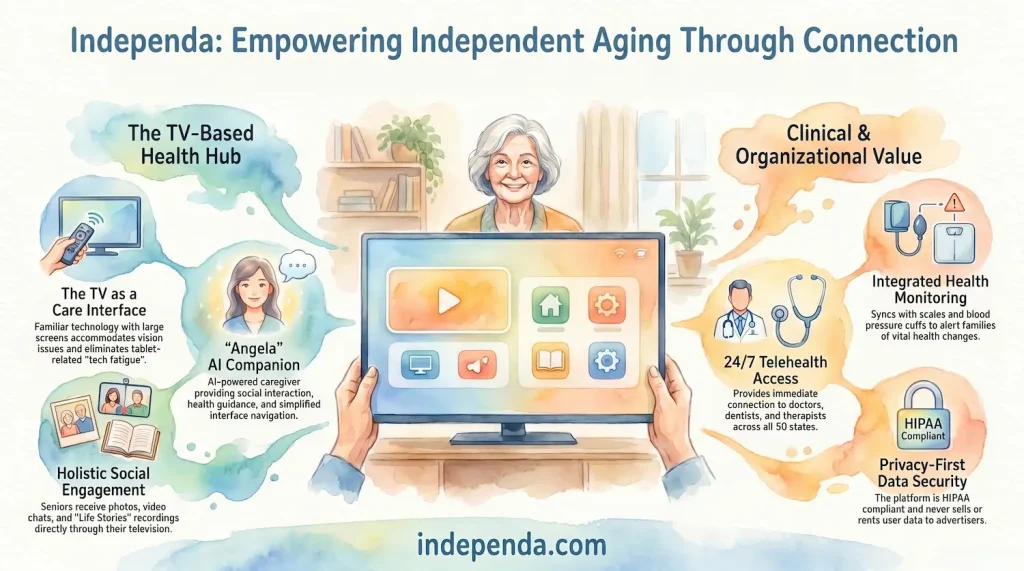
This is why I find the idea behind platforms like Independa so interesting.
Instead of forcing seniors to learn entirely new devices, the platform works through something most older adults already know how to use: the television.
That matters more than people realize.
The TV is:
- Familiar
- Comfortable
- Easy to see
- Already part of daily routines
- Usually located in the center of the home
For many seniors, the television is not just entertainment. It is part of their daily rhythm and connection to the outside world.
Using the TV as a care platform removes many of the barriers that make other technologies difficult.
- There are no tiny screens to squint at.
- No forgotten charging cables.
- No device lost in couch cushions.
Instead, the television becomes a hub for:
- Video calls
- Wellness check-ins
- Medication reminders
- Calendars
- Educational content
- Social connection
- Health-related communication
And in my opinion, this is where the conversation about aging in place needs to go.
- Not just safety.
- Connection.
The Real Secret: Technology That Feels Human
One thing I appreciated about Independa’s approach is the focus on companionship instead of pure medical monitoring.
Their AI companion, Angela, is designed to feel conversational and supportive rather than cold or clinical.
That may sound small, but emotionally it is huge.
Older adults are far more likely to use technology consistently when it feels friendly, calming, and useful in everyday life.
As an OT, I learned very quickly that people resist systems that make them feel incompetent. But they engage with systems that help them feel successful.
That is an important difference.
The goal should never be to overwhelm seniors with technology. The goal should be to quietly support their independence while preserving dignity.
Privacy Matters More Than Ever
I also think families are becoming increasingly concerned about privacy.
Many smart devices collect enormous amounts of personal data. Seniors often do not fully understand what information is being shared, tracked, or sold.
That can create real trust issues.
Older adults deserve technology that respects them, not technology that treats them like data points.
Families are not just buying convenience anymore. They are buying peace of mind.
And trust is part of that equation.
Aging in Place Is About More Than Preventing Falls
Fall prevention matters. Home safety matters. Medication reminders matter.
But aging in place is about something deeper too.
It is about helping someone continue to feel:
- Connected
- Seen
- Independent
- Involved
- Valued
I think sometimes the healthcare system becomes so focused on “risk reduction” that we forget older adults are still people who want joy, conversation, purpose, humor, and relationships.
Technology should support the whole person.
Not just the diagnosis.
“80 Is 80”
One part of this conversation really stood out to me.
The idea that while people are healthier longer today, there still comes a point where aging changes the body in very real ways.
And honestly, I think families need to hear that.
There is nothing wrong with needing support as we age.
The goal is not to pretend aging is not happening. The goal is to create environments and systems that make aging feel safer, easier, and less isolating.
That includes simple technology.
In fact, I would argue that simplicity is one of the highest forms of respect we can offer older adults.
Final Thoughts
The future of aging in place may not come from complicated robots or overwhelming gadgets. It may come from using familiar tools in smarter, kinder ways.
Sometimes the best technology is not the newest thing.
Sometimes it is the technology older adults already trust.
And for many seniors, that trusted technology is sitting right there in the living room.
