
 Aging in Place Directory Hub
| Quick Answer What should you do if your aging parent lives on the second floor? If your aging parent lives on the second floor, your first step is to assess the staircase for fall risks and add safety features like a sturdy handrail on both sides, non-slip treads, and good lighting. Then consider whether a bedroom or bathroom on the main floor is possible, to reduce daily stair use. With the right modifications, many older adults can continue living safely in a two-story home. |
My client Margaret called me on a Tuesday afternoon, voice tight with worry. Her 79-year-old mother, Dolores, had been living in the same two-story house for 40 years, but a recent fall on the stairs had shaken the whole family. “She refuses to move,” Margaret said. “But I can’t stop thinking about those stairs.”
I hear this kind of concern often. Stairs are one of the most common fall hazards in a senior’s home, and when a parent’s bedroom, bathroom, or daily life is on the second floor, the risk feels very real. But moving isn’t always the right answer, and it certainly isn’t always what your parent wants.
The good news is that with the right plan, many older adults can continue living safely in a two-story home. This article walks you through exactly what to look for, what to change, and when to have a harder conversation.
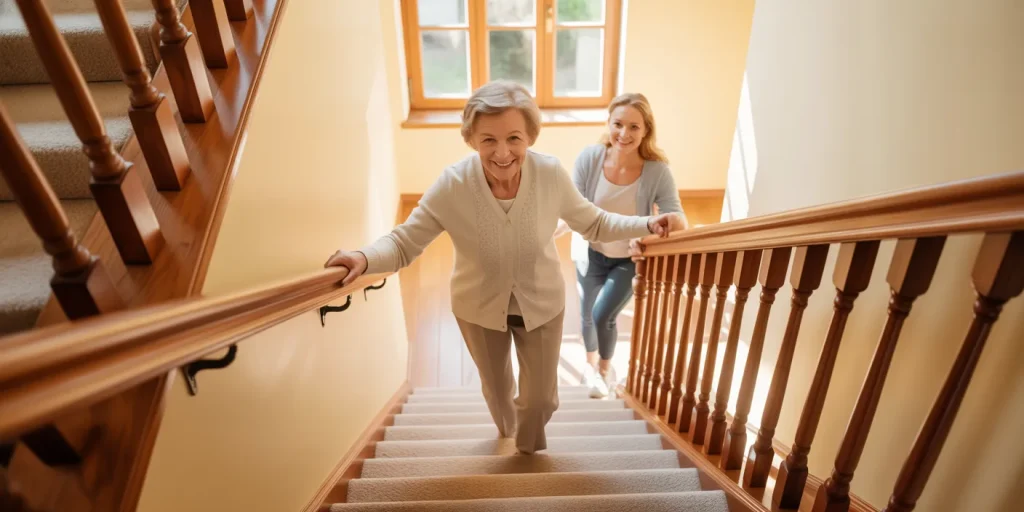
Is It Safe for an Aging Parent to Live on the Second Floor?
Whether it is safe for an aging parent to live on the second floor depends on their physical abilities, the condition of the staircase, and whether modifications have been made. Many older adults can continue using stairs safely with the right handrails, lighting, and support. The key is an honest assessment of both the person and the home.
Stairs become riskier as we age because of changes in balance, leg strength, vision, and reaction time. These are normal parts of aging, not signs that a person must move. What they do mean is that the home needs to work harder to support the person who lives in it.
As an occupational therapist, I always began with a home safety assessment before making any recommendations. The staircase, the bedroom, the bathroom, and the daily routine all need to be part of the picture. One change rarely tells the whole story.
Why Are Stairs a Risk for Older Adults?
Stairs are a leading cause of fall-related injuries in older adults because they require strength, balance, coordination, and good vision all at the same time.
As any one of these abilities declines, even familiar stairs in a lifelong home can become dangerous. The risk increases further if the stairs are poorly lit, steep, or lack a handrail.
Falls on stairs are particularly dangerous because they often result in serious injury. A fall on a flat floor is bad enough. A fall on stairs means tumbling down multiple steps, which significantly increases the chance of a broken hip, head injury, or fracture.
Several factors can make stairs harder to navigate safely.
These include:
- Reduced leg strength or hip flexibility
- Balance problems or dizziness from medications
- Vision changes, including difficulty seeing in low light
- Cognitive changes that affect attention or judgment
- Arthritis or joint pain that makes gripping a railing harder
- Fatigue, especially later in the day
Medications are worth a specific mention. Many common drugs taken by older adults, including blood pressure medications, sleep aids, and certain pain relievers, can cause dizziness, lightheadedness, or slower reaction times.
This is a conversation worth having with your parent’s doctor or pharmacist.
What Signs Tell You the Stairs Are No Longer Safe?
Signs that stairs may no longer be safe for your parent include holding the wall instead of the railing, pausing halfway up to rest, skipping the stairs by avoiding the second floor altogether, or expressing fear about using them.
Any of these behaviors tells you something important, even if your parent won’t say so directly.
People often adapt quietly to a growing limitation. They might stop going upstairs to get something, or they might start sleeping on the couch instead of in their bedroom. These workarounds are easy to miss, but they matter.
| Watch For This | What It May Mean |
| Holding the wall instead of the railing | Handrail may be missing, too low, or hard to grip |
| Pausing midway on the stairs | Reduced strength or cardiopulmonary endurance |
| Avoiding the second floor | Fear of falling or pain during stair use |
| Scuffing feet on stair edges | Reduced foot clearance, a tripping risk |
| Going up or down only one step at a time | Balance or strength concerns |
| Gripping the railing very tightly | Relying heavily on upper body for stability |
| Reluctance to use the stairs at night | Poor lighting or fear of nighttime dizziness |
It is also worth asking your parent directly how they feel about the stairs. Many older adults will admit to feeling nervous if someone simply asks. That honesty opens the door to a helpful conversation rather than a defensive one.
What Should You Do If Your Parent Lives on the Second Floor?
| What To Do First What should you do if your aging parent lives upstairs? Start with a staircase safety check: add a handrail on both sides, install non-slip treads, and improve lighting. Then consider moving the bedroom and a bathroom to the main floor if possible. If stairs are truly unsafe, a stairlift or elevator may be the right long-term solution. |
Here is how I recommend working through this, step by step.
Start with the staircase itself. A safe staircase needs:
- A sturdy handrail on both sides of the staircase, running the full length
- Non-slip treads or grip tape on each step
- A light switch at both the top and the bottom of the stairs
- Adequate lighting, especially at night (a plug-in night light works well)
- Steps that are clear of any clutter, cords, or loose rugs
Next, think about the daily routine. How often does your parent go up and down the stairs each day, and why? If the bedroom and only bathroom are upstairs, that is a different situation than if they are simply going up to retrieve something occasionally.
If at all possible, consider relocating the essentials to the main floor. A bedroom on the ground level, even a converted dining room or den, and access to a main-floor bathroom can dramatically reduce how often your parent needs to use the stairs.
This one change often eliminates most of the daily risk.
When I was working with Dolores, we found that her main bathroom was upstairs, which meant four or five trips every day. We worked with the family to convert a half-bath on the main floor to a full bath with a walk-in shower.
Dolores kept her bedroom upstairs because she wanted to, but she used the stairs far less often, and only during the day when she was alert and rested.
What Tools and Modifications Can Help?
Several home modifications and assistive tools can make a second-floor setup safer for an older adult. The most effective options include adding handrails on both sides of the staircase, installing a stairlift, improving lighting, and using a medical alert system so that help is available quickly if a fall occurs.
Here is a practical overview of the options most worth considering:
- Stairlifts: A motorized chair that rides a rail along the staircase. These are highly effective for people who lack the strength or balance to use stairs safely. They require professional installation and range in cost from around $3,000 to $10,000 depending on staircase design.
- Vertical platform lifts: A small elevator-style lift that works for short rises, particularly useful if the staircase is L-shaped or too narrow for a standard stairlift.
- Grab bars and handrails: Inexpensive and highly effective. Both sides of the staircase should have a full-length rail that is easy to grip. Standard residential rails are often too low or not anchored well enough.
- Non-slip stair treads: Adhesive or carpet-style treads that add grip to each step. Available at any hardware store and easy to install.
- Lighting upgrades: Motion-activated lights along the staircase or at each landing make nighttime trips much safer.
- Medical alert systems: Wearable devices that allow your parent to call for help if they fall. Some include fall detection that calls for help automatically.
For families wondering about costs, there are financial assistance programs worth exploring. Some state Medicaid waiver programs cover home modification costs.
Veterans may qualify for the VA’s Home Improvements and Structural Alterations (HISA) grant. AARP and many Area Agencies on Aging can connect families to local low-cost modification programs.
When Should You Be More Worried and Take Action?
You should be more worried, and take action quickly, if your parent has already fallen on the stairs, if they have a new diagnosis that affects balance or cognition, or if they are avoiding the stairs out of fear but the upper floor still contains their bedroom or bathroom.
These situations call for immediate changes, not a wait-and-see approach.
A prior stair fall is the clearest signal that the current situation is not working. Even a near-miss, a slip that was caught, or a moment of losing balance should be treated seriously. These incidents are not just unlucky moments. They are information.
New diagnoses also change the math quickly. A diagnosis of Parkinson’s disease, a stroke, significant vision loss, or any condition affecting cognition means the staircase needs to be reassessed right away, not at some future point when things get worse.
Here is a simple way to think about it:
| Situation | Recommended Action |
| No falls, uses stairs with confidence | Staircase safety check and lighting upgrade |
| Occasional unsteadiness on stairs | Add handrails both sides, non-slip treads, light switches top and bottom |
| One fall or near-miss on stairs | Urgent home safety assessment, consider stairlift |
| Avoids stairs but needs them daily | Immediate plan to relocate bedroom or bathroom to main floor |
| New diagnosis affecting balance or cognition | Reassess immediately, consult OT |
| Multiple falls or serious injury on stairs | Stairlift, elevator, or move to single-story living |
If your parent is resistant to making changes, I find it helps to frame modifications around independence rather than safety. A stairlift does not mean giving up. It means being able to stay in the home they love.
Most older adults respond much better to that framing than to warnings about what might happen if they do not act.
A Final Thought
Dolores is still in her two-story home. She is 83 now, and she sends Margaret a photo every Sunday morning from the kitchen, coffee in hand, sunlight coming through the window she has looked out for four decades.
Getting there took some work. A new handrail. Better lighting. A main-floor bathroom. A stairlift she resisted for two years and now says she wishes she had gotten sooner.
The stairs did not have to be the reason she lost her home. They just needed a plan.
If your parent is living on the second floor and you are worried, you are right to pay attention. Start with the staircase. Look at the daily routine. Ask the honest questions. And if you are not sure where to begin, a Certified Aging-in-Place Specialist or an occupational therapist can help you see the home through fresh eyes.
Your parent’s home holds 40 or 50 years of their life. With the right support, it can hold more.
Frequently Asked Questions
| Question | Answer |
| Can an elderly person safely use stairs? | Many older adults can use stairs safely with proper handrails on both sides, non-slip treads, good lighting, and light switches at both ends. The key is matching the environment to the person’s current physical abilities. |
| What is the safest way for a senior to go up and down stairs? | Use both handrails, take one step at a time, move slowly, and never carry anything that blocks the hands. Avoid using the stairs when fatigued or after taking medications that cause dizziness. |
| How much does a stairlift cost? | Stairlifts typically cost between $3,000 and $10,000 depending on staircase design and features. Some financial assistance programs are available through state Medicaid waivers, VA grants, and Area Agencies on Aging. |
| What is the first thing to do if I am worried about my parent on the stairs? | Walk the staircase yourself and check for handrails on both sides, non-slip treads, and good lighting. Then watch your parent use the stairs once and note any hesitation, gripping, or pausing. Those observations will guide next steps. |
| When should a senior stop using stairs? | A senior should stop using stairs independently when they have had a fall on the stairs, express fear about using them, or have a condition that significantly affects balance or cognition. A stairlift or main-floor living arrangement is the safer alternative. |
| Does Medicare cover stairlifts? | Original Medicare does not cover stairlift costs. Some Medicare Advantage plans may offer home modification benefits. State Medicaid programs and veteran benefits may also provide assistance. |
